About 139 minutes
With the French Flying Corps — Inside the Classic
World Events
31,883 recorded words. 2 minutes difference from this book's estimate.
View Gutenberg source #46299
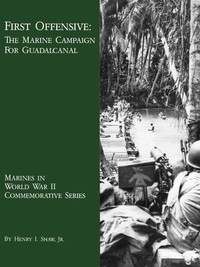
Before opening First Offensive: The Marine Campaign for Guadalcanal — Edition Insights, the edition data offers a quick orientation: 31,346 words, 2 hr 17 min estimated reading time, and 23 detected text sections.
The text analysis averages about 19.9 words per sentence, while the detected sections provide another way to judge how the source is divided.
Project Gutenberg metadata also associates the work with “Guadalcanal, Battle of, Solomon Islands, 1942-1943,” connecting these edition facts with the source record’s subject description.
Explore this collection
These alternatives are selected using recorded categories and estimated reading time.
About 139 minutes
World Events
31,883 recorded words. 2 minutes difference from this book's estimate.
View Gutenberg source #46299About 132 minutes
World Events
30,220 recorded words. 5 minutes difference from this book's estimate.
View Gutenberg source #10837About 129 minutes
World Events
29,660 recorded words. 8 minutes difference from this book's estimate.
View Gutenberg source #15896Search stored excerpts and compare books → Choose by your preferences →
Choices use stored catalog measurements. Estimates vary with reading speed. A shared category is a catalog label, not a claim that two books have the same argument or literary quality.
Search reads excerpt text stored with this catalog and links to its associated Gutenberg record. The connection is stored in the site database; this tool does not recheck that every excerpt is word-for-word identical to that external record. Excerpt search does not cover every chapter and does not verify historical publication dates.
Catalog snapshot checked: 2026-09-25. Coverage: 91 public books, 91 available source excerpts.
Read the complete public-domain text at its original source.
Read on Project GutenbergHenry I. Shaw's First Offensive: The Marine Campaign for Guadalcanal opens with intelligence reports of a Japanese airfield under construction near Lunga Point, triggering a demand for offensive action. The narrative quickly establishes the strategic stakes: the airfield threatened Allied supply lines to New Zealand and Australia. Shaw grounds the campaign in specific decisions by Admiral King and Admiral Nimitz, but the excerpts focus less on high-level command and more on the gritty details of ground combat.
The excerpts devote considerable space to the Matanikau River actions in October 1942. Shaw describes a coordinated attack involving five infantry battalions and the Whaling group, with precise movements: Whaling's force thrust inland, followed by two battalions of the 7th Marines driving toward the coast. The 5th Marines' assault battalions encountered Japanese in strength about 400 yards from the river, leading to intense fighting. Shaw notes that rain on the 8th virtually stopped forward progress but did not halt close-in combat. The Japanese attempted to retreat but smashed into a raider position, resulting in a wild hand-to-hand battle. These passages reveal a focus on unit maneuvers and the physical conditions of jungle warfare.
The table of contents lists numerous sidebars that supplement the main narrative: General Vandegrift, the first Marine utility uniform, the LVT (1) 'Amtrac,' the 37mm antitank gun, the Reising gun, the 75mm pack howitzer, and the Japanese Model 89 grenade discharger. These sidebars indicate that Shaw intended the pamphlet to serve as both a historical account and a reference for military equipment. The excerpts themselves, however, do not include the sidebar content, so the reader must infer their role from the listing. The sidebars on Coastwatchers and Sergeant Major Vouza hint at the inclusion of local intelligence and individual heroism.
The catalog subjects list Vandegrift, Marine Corps history, and the Guadalcanal battle. While Vandegrift appears in the excerpts—awarding Navy Crosses and receiving a visit from Nimitz—the narrative does not center on his personal story. Instead, Shaw emphasizes the actions of battalion commanders like Puller, Edson, and Whaling, and the experiences of ordinary Marines. The subject 'United States. Marine Corps -- History -- World War, 1939-1945' fits, but the excerpts show a narrower focus on ground combat rather than broader Marine Corps history. The pamphlet's structure as a commemorative series entry suggests it aims to honor specific units and engagements, not to provide a comprehensive strategic overview.
Readers should approach this pamphlet as a tactical narrative rather than a full campaign history. The sidebars, though not excerpted, likely provide valuable context on equipment and key figures. Pay attention to the detailed descriptions of unit movements and terrain, which distinguish this work from more general accounts. The excerpts suggest a text that rewards careful reading of military terminology and geography.
I’ve spent long afternoons among these shelves, and a certain kinship binds the Guadalcanal pamphlet and How I Filmed the War A Record of the Extraordinary Experiences of the Man Who Filmed the Great Somme Battles, etc. — Edition Insights. Both hold the grit of history in a private, mortal grip—the mud, the patience, the silent waiting before the storm. Their photographs are keepers of ghosts, and their pages, old friends.
Save your reaction, strongest insight, and memorable passage.









