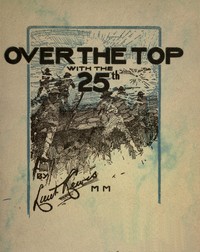
Lewis opens his chronicle not in the trenches but aboard a Labrador steamboat, where news from the front overrides his captain's pleas to stay. This civilian-to-soldier transition sets the tone: a personal, almost offhanded account that treats enlistment as a straightforward duty. The narrative voice is that of a participant who admires his unit—the 25th Battalion—yet writes with a digressive, diary-like intimacy. He notes that the battalion spent nineteen months in France before any other Nova Scotia unit saw action, a point he makes without boastfulness but as context for why the 25th's story is less known. The prose moves from broad chronology to sudden, vivid details: the Pipe Band's goat mascot, trench songs, and the colonel's bandaged hand. This blend of official record and informal observation shapes the entire work.
Voice of the Fighting Twenty-Fifth
Lewis writes as an insider, using first-person plural and possessive phrases like “our most amiable friend Fritz” or “the grand old Twenty-Fifth.” This collective identity is reinforced by recurring references to unit pride: “we were still the '25th' and could show the Germans what we could do.” The tone is often conversational, even when describing casualties. After losing “quite a few of our best pals,” he remarks that dwelling on it would make “good patients for a lunatic asylum.” Such dark humor is a deliberate narrative strategy, not callousness—it reflects the soldiers' coping mechanism. The voice also shifts between formal report and anecdote. When Lewis recounts his encounter with Colonel Hilliam, who jokes about his surname suiting a Lewis Gun team leader, the exchange is rendered in direct dialogue, breaking the chronicle's chronological flow for a character moment. This oscillation between distance and intimacy is a key feature of the text.
Pace and the Rhythm of Rest and Action
The narrative pace mirrors the battalion's experience: bursts of intense action followed by slower, almost leisurely passages. Lewis describes the Arleux fighting in a single compressed sentence—“we were able to take all our objectives and consolidate them”—then lingers on the aftermath: the ride in London Motor Buses, shaving and cleaning up, selling souvenirs. The phrase “we were all as happy as larks” contrasts sharply with the preceding combat. This rhythm is not accidental; Lewis uses it to convey the psychological whiplash of trench warfare. He also marks time through logistics: the arrival of rations, the location of reserve trenches, the reorganization parades. These details anchor the reader in the soldiers' daily reality, where waiting and moving are as significant as fighting. The pace slows further during rest periods, allowing for character vignettes—the colonel's modesty, the mascot goat leading the band—that humanize the unit.
Recurring Details as Structural Anchors
Certain objects and phrases recur, giving the chronicle a cohesive texture. The Lewis Gun appears multiple times: Lewis is placed in charge of a Lewis Gun team, and the colonel's pun on his name ties the weapon to the author's identity. The battalion mascot, a goat acquired in 1915, is mentioned twice, always leading the Pipe Band—a symbol of continuity amid turnover. Helmets and revolvers taken from German soldiers are noted as souvenirs, then sold in anticipation of future action, suggesting a cycle of acquisition and loss. Even the phrase “esprit de corp” (misspelled) is used self-consciously, as Lewis explains that the battalion's pride was performative: “we used always to show an example to the others.” These details are not decorative; they function as touchstones that ground the narrative in material culture and unit traditions, helping readers track the battalion's journey through the fragmented chronology of war.
Lewis's chronicle is best approached as a hybrid document—part personal diary, part unit history. Readers should pay attention to shifts in verb tense and sentence length, which signal changes in emotional register. The author's omissions are as telling as his inclusions: he rarely describes enemy soldiers or strategic decisions, focusing instead on the battalion's internal life. The text rewards those who read for voice and pacing rather than for a comprehensive battle narrative.
Reading Lieutenant Lewis’s diary entries about the mud and dark humor at Courcelette, I found myself thinking about how we later tried to make sense of it all. His voice is so immediate, so alive, that it made me long for a gentler hand to guide my understanding. That’s where In the World War — A Reader’s Guide came to mind, like a quiet companion for those restless thoughts.