About 446 minutes
Memories — Key Ideas to Explore
Social History
102,400 recorded words. 15 minutes difference from this book's estimate.
View Gutenberg source #15829
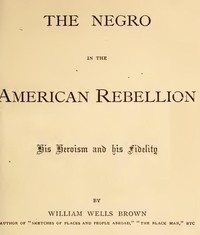
For The Negro in the American Rebellion: His Heroism and His Fidelity — Text and Context, the stored edition analysis reports 105,871 words, 7 hr 41 min estimated reading time, and 14 detected text sections.
The text analysis averages about 20.9 words per sentence, while the detected sections provide another way to judge how the source is divided.
Project Gutenberg metadata also associates the work with “African American soldiers -- History -- 19th century,” connecting these edition facts with the source record’s subject description.
Explore this collection
These alternatives are selected using recorded categories and estimated reading time.
About 446 minutes
Social History
102,400 recorded words. 15 minutes difference from this book's estimate.
View Gutenberg source #15829About 393 minutes
Social History
90,284 recorded words. 68 minutes difference from this book's estimate.
View Gutenberg source #6764About 326 minutes
Social History
74,890 recorded words. 135 minutes difference from this book's estimate.
View Gutenberg source #20928Search stored excerpts and compare books → Choose by your preferences →
Choices use stored catalog measurements. Estimates vary with reading speed. A shared category is a catalog label, not a claim that two books have the same argument or literary quality.
Search reads excerpt text stored with this catalog and links to its associated Gutenberg record. The connection is stored in the site database; this tool does not recheck that every excerpt is word-for-word identical to that external record. Excerpt search does not cover every chapter and does not verify historical publication dates.
Catalog snapshot checked: 2026-09-25. Coverage: 91 public books, 91 available source excerpts.
Read the complete public-domain text at its original source.
Read on Project GutenbergWilliam Wells Brown opens The Negro in the American Rebellion with a preface stating his aim to “preserve for future reference an account of the part which the Negro took in suppressing the Slaveholders’ Rebellion.” The book is not a conventional military history but a compilation of evidence—official reports, newspaper reprints, and personal narratives—arranged chronologically from the Revolutionary War through Reconstruction. Brown, a former fugitive slave and prolific author, wrote in 1867, just two years after the war ended, making this one of the earliest sustained efforts to document Black military service and citizenship claims.
The table of contents reveals a deliberate structure. Brown begins with earlier insurrections—Nat Turner, slave revolts at sea, John Brown’s raid—before reaching the Civil War. This framing argues that Black resistance was not new but continuous. The war chapters are organized by battle or campaign (Milliken’s Bend, Port Hudson, Fort Wagner), but Brown also includes thematic chapters like “Intelligent Contrabands” and “Wit and Humor of the War.” The final chapters address postwar injustices: “Ill Treatment of Colored People South” and “Caste.” This arc from heroism to ongoing struggle is the book’s implicit thesis.
A striking excerpt reproduces a New York Times report from July 14, 1863, describing the burning of the Colored Orphan Asylum during the New York City draft riots. The account details how Chief Engineer Decker repeatedly extinguished flames set by a mob “of women and children” until he was overpowered. The orphans—boys from “two and three to fifteen years of age”—are marched to safety. Brown includes this not as a battle narrative but as evidence of civilian violence against Black communities, showing his book’s scope beyond the battlefield.
Brown frequently lets contemporary documents speak. The asylum account is one example; elsewhere he quotes soldiers’ letters, official correspondence, and speeches. He credits George Livermore for Revolutionary War data. This method gives the book a documentary texture, though Brown’s own voice emerges in chapter headings and transitions. The excerpts do not show Brown analyzing these sources; he presents them as self-evident proof. Readers should note that the book is a curated archive, not a synthetic narrative, and that Brown’s selections reflect his advocacy for full citizenship.
Brown’s book is best approached as a primary source in its own right—a record of how a Black author in 1867 chose to assemble evidence of African American military service and suffering. Readers should attend to what Brown includes (battles, riots, political events) and what he omits (Confederate sources, detailed tactical analysis). The excerpts suggest a work driven by moral urgency rather than scholarly detachment, making it valuable for understanding Reconstruction-era historical memory.
I have spent many years shelving histories of men who fought to be remembered. William Wells Brown’s chronicle of Black soldiers’ fidelity always feels like holding a lantern to a forgotten window. It reminds me of another quiet kind of courage, found in the escape of an airman, a different war, same stubborn will to narrate one’s own survival. Both simply endure. "Brother Bosch", an Airman's Escape from Germany — Context and Discussion keeps that same faithful voice.
Build a private reading journal entry for this title.