About 467 minutes
Gallipoli Diary, Volume 1 — A Closer Reading
World Events
107,270 recorded words. 3 minutes difference from this book's estimate.
View Gutenberg source #19317
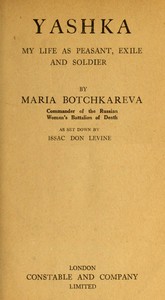
Before opening Yashka — Story, Setting & Ideas, the edition data offers a quick orientation: 106,606 words, 7 hr 44 min estimated reading time, and 25 detected text sections.
The text analysis averages about 14.0 words per sentence, while the detected sections provide another way to judge how the source is divided.
Project Gutenberg metadata also associates the work with “Soviet Union -- History -- Revolution, 1917-1921,” connecting these edition facts with the source record’s subject description.
Explore this collection
These alternatives are selected using recorded categories and estimated reading time.
About 467 minutes
World Events
107,270 recorded words. 3 minutes difference from this book's estimate.
View Gutenberg source #19317About 479 minutes
World Events
110,098 recorded words. 15 minutes difference from this book's estimate.
View Gutenberg source #17369About 423 minutes
World Events
97,139 recorded words. 41 minutes difference from this book's estimate.
View Gutenberg source #22021Search stored excerpts and compare books → Choose by your preferences →
Choices use stored catalog measurements. Estimates vary with reading speed. A shared category is a catalog label, not a claim that two books have the same argument or literary quality.
Search reads excerpt text stored with this catalog and links to its associated Gutenberg record. The connection is stored in the site database; this tool does not recheck that every excerpt is word-for-word identical to that external record. Excerpt search does not cover every chapter and does not verify historical publication dates.
Catalog snapshot checked: 2026-09-25. Coverage: 91 public books, 91 available source excerpts.
Read the complete public-domain text at its original source.
Read on Project GutenbergMaria Bochkareva's narrative voice, as recorded by Isaac Don Levine, is blunt and unadorned, shaped by her semi-illiteracy and her determination to set the record straight. The memoir opens with a childhood of toil in rural Siberia, where she describes her father's harshness and her early marriage at fifteen. The prose is direct, often repeating phrases for emphasis, and the dialogue—whether with officers, mutineers, or Bolsheviks—is rendered in short, imperative bursts that reflect her command style. Levine's introduction notes that foreign journalists frequently misrepresented her, and this autobiography aims to correct that, though it remains mediated by his transcription and translation.
Bochkareva's diction is consistently confrontational and physical. She addresses her battalion as 'foolish women' and tells mutineers they are 'not worthy of the uniforms you are wearing.' Her speeches are built around stark binaries: action versus phrases, sacrifice versus disgrace, holiness versus scandal. She frames the battalion as a 'holy place' and prays for chastity, yet her commands are laced with threats and ultimatums. This tension between spiritual aspiration and military pragmatism recurs throughout the excerpt, as when she insists that committees 'paralyse action by a flood of words.' The language is rarely abstract; even her appeals to patriotism are grounded in concrete images of uniforms, bullets, and the front.
The excerpt from Chapter XII reveals Bochkareva's leadership style through direct confrontation. She faces a split battalion: three hundred loyal women on the left, mutineers on the right. Her response is theatrical—she turns to each group separately, demanding a show of hands. The mutineers' objections are framed as demands for liberty and courteous treatment, which she dismisses as 'phrases.' The scene escalates into a night-long argument, with Bochkareva retiring in despair while officers handle the rebels. Her description of the mutineers as 'babas' (a derogatory term for women) and her insistence that they 'take it off and leave' underscore her contempt for what she sees as weakness. The episode is structured as a series of rhetorical exchanges, each punctuated by her emotional reactions—'deeply hurt,' 'filled with despair,' 'soul ached.'
Levine's introduction is candid about the book's construction: Bochkareva recited her story in Russian, and he recorded it in English. This dual authorship raises questions about voice. The English prose is fluent but retains a certain roughness—repetitions like 'I told you beforehand that it would be hard' and 'I wanted this house to be a holy place' suggest an oral origin. Levine notes that she was 'semi-illiterate' and could not write a letter fluently, so the memoir is necessarily a collaboration. The reader encounters not a direct transcript but a shaped narrative, one that Bochkareva approved as 'a complete record of her life.' The tension between her raw testimony and Levine's editorial hand is part of the text's texture.
The physical settings in the excerpt are minimal but charged. The battalion's quarters become a 'holy place' that Bochkareva tries to keep pure by restricting walks and holidays. The mutineers' complaint to General Polovtzev moves the conflict to a military office, where the General advises compromise. Bochkareva's refusal to accept committees is set against the broader army's committee rule, which she sees as a betrayal of the battalion's purpose. The front itself is absent from this passage, but it looms as the ultimate test: she warns that a committee might 'suddenly decide not to advance,' rendering the battalion useless. The setting is thus less geographic than ideological—a space where discipline and democracy clash, and where Bochkareva's authority is both asserted and undermined.
Readers should attend to the interplay between Bochkareva's direct speech and Levine's framing. The memoir is not a neutral record but a strategic self-portrait, shaped by its moment of composition in 1918. The dialogue, in particular, rewards close reading: it reveals how Bochkareva performed leadership and how she wanted that performance remembered. The book's value lies less in its factual completeness than in its unvarnished depiction of one woman's attempt to impose order on chaos, and the costs of that attempt.
There’s a particular ache in Bochkareva’s words, that raw edge of duty worn down to bare bone. Reading her, I kept thinking of the wider fog she marched through. That quieter companion volume, Inside the Russian Revolution — A Reader’s Guide, sits beside my copy now, though I haven’t opened it yet. Some afternoons, you just want to sit with the echo.
Save your reaction, strongest insight, and memorable passage.









