About 199 minutes
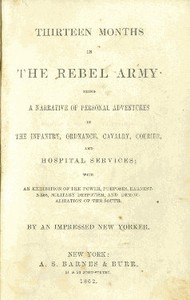
Thirteen months in the Rebel Army — Background and Themes
Modern Nations
45,629 recorded words. 4 minutes difference from this book's estimate.
View Gutenberg source #15644

Andersonville: A Story of Rebel Military Prisons — Volume 2 — Reading Notes can be approached with a clearer sense of reading commitment from its source measurements: 44,744 words, 3 hr 15 min estimated reading time, and 6 detected text sections.
The text analysis averages about 23.4 words per sentence, while the detected sections provide another way to judge how the source is divided.
Project Gutenberg metadata also associates the work with “Andersonville Prison,” connecting these edition facts with the source record’s subject description.
Explore this collection
These alternatives are selected using recorded categories and estimated reading time.
About 199 minutes
Modern Nations
45,629 recorded words. 4 minutes difference from this book's estimate.
View Gutenberg source #15644About 186 minutes
Modern Nations
42,682 recorded words. 9 minutes difference from this book's estimate.
View Gutenberg source #46116About 233 minutes
Modern Nations
53,503 recorded words. 38 minutes difference from this book's estimate.
View Gutenberg source #21977Search stored excerpts and compare books → Choose by your preferences →
Choices use stored catalog measurements. Estimates vary with reading speed. A shared category is a catalog label, not a claim that two books have the same argument or literary quality.
Search reads excerpt text stored with this catalog and links to its associated Gutenberg record. The connection is stored in the site database; this tool does not recheck that every excerpt is word-for-word identical to that external record. Excerpt search does not cover every chapter and does not verify historical publication dates.
Catalog snapshot checked: 2026-09-25. Coverage: 91 public books, 91 available source excerpts.
Read the complete public-domain text at its original source.
Read on Project GutenbergMcElroy devotes considerable attention to the organized criminal gangs known as the Raiders, who preyed on fellow prisoners with methods ranging from sneak thievery to armed robbery. He notes that the Raiders could concentrate up to five hundred men, having learned their trade in New York's prisons and purlieus. The text distinguishes between prisoners from the Army of the Potomac, who often arrived with belongings untouched, and Sherman's men, who were stripped nearly to the buff. This disparity in treatment reveals a systematic exploitation within the prison's informal economy.
McElroy describes the Raiders' operations as a blend of urban criminal arts adapted to the prison pen. Decoys, or 'bunko-steerers,' would lure fresh prisoners to secluded spots for nighttime robbery. Victims who resisted were often killed—throats cut or skulls crushed—their bodies found among the dead at the gates. The gangs used slung-shots, brass-knuckles, and smuggled bowie-knives, and they coordinated attacks with swift dexterity. By June, they operated in broad daylight, with the cry of 'Raiders!' echoing hourly. McElroy emphasizes the Raiders' advantage of mutual acquaintance, while the general prison population consisted of small, isolated squads from different regiments, making organized resistance difficult.
The text highlights a notable difference in how prisoners from the Eastern and Western armies were treated upon arrival. Those from the Army of the Potomac were searched less thoroughly, often retaining their valuables, while Sherman's men were stripped nearly to the buff. This discrepancy, McElroy suggests, reflected the Rebels' varying procedures. The 'Plymouth Pilgrims'—a group captured at Plymouth, North Carolina—are mentioned as an exception, having arrived from comfortable barracks and suffering a sad transition. McElroy also notes the presence of a crazed Pennsylvanian, illustrating the psychological toll of captivity.
McElroy documents the pervasive violence as a routine part of prison life. He states that severe engagements between Raiders and their victims were continual, with men beaten so badly they died from the effects. Weapons included fists, clubs, axes, and tent-poles. The guards' shooting of men at the Creek crossing is mentioned as equally common as the Raiders' forays. The text conveys a sense of constant danger: 'there was hardly an hour in the twenty-four that the cry of "Raiders! Raiders!" did not go up.' This atmosphere of terror, combined with diminishing rations and disease, created a desperate struggle for survival.
Readers should note that McElroy's account is a personal narrative, not a comprehensive history. His observations are grounded in his own experience as a private soldier, and he does not claim to speak for all prisoners. The volume focuses on the internal dynamics of the prison, particularly the conflict between the Raiders and the general population, offering a microcosm of society under extreme duress.
Reading about the Raiders’ organized cruelty, I remembered my grandfather’s stories of prison camp—not Andersonville, but a quieter endurance. He never spoke of violence, only of the boys who held the line for one another. The Irish at the Front — Edition Insights stirred that same ache, the strange fellowship forged in misery. Both books left me holding my breath long after the page turned.
Build a private reading journal entry for this title.