About 195 minutes
Andersonville: A Story of Rebel Military Prisons — Volume 2 — Reading Notes
Modern Nations
44,744 recorded words. 4 minutes difference from this book's estimate.
View Gutenberg source #4258
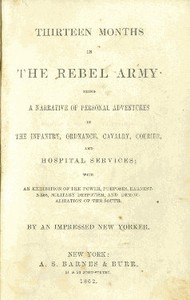
The source record for Thirteen months in the Rebel Army — Background and Themes measures this digital text at 45,629 words, 3 hr 19 min estimated reading time, and 5 detected text sections.
The text analysis averages about 20.7 words per sentence, while the detected sections provide another way to judge how the source is divided.
Project Gutenberg metadata also associates the work with “United States -- History -- Civil War, 1861-1865 -- Personal narratives, Confederate,” connecting these edition facts with the source record’s subject description.
Explore this collection
These alternatives are selected using recorded categories and estimated reading time.
About 195 minutes
Modern Nations
44,744 recorded words. 4 minutes difference from this book's estimate.
View Gutenberg source #4258About 186 minutes
Modern Nations
42,682 recorded words. 13 minutes difference from this book's estimate.
View Gutenberg source #46116About 233 minutes
Modern Nations
53,503 recorded words. 34 minutes difference from this book's estimate.
View Gutenberg source #21977Search stored excerpts and compare books → Choose by your preferences →
Choices use stored catalog measurements. Estimates vary with reading speed. A shared category is a catalog label, not a claim that two books have the same argument or literary quality.
Search reads excerpt text stored with this catalog and links to its associated Gutenberg record. The connection is stored in the site database; this tool does not recheck that every excerpt is word-for-word identical to that external record. Excerpt search does not cover every chapter and does not verify historical publication dates.
Catalog snapshot checked: 2026-09-25. Coverage: 91 public books, 91 available source excerpts.
Read the complete public-domain text at its original source.
Read on Project GutenbergWilliam G. Stevenson’s narrative opens with a striking claim: he is an “Impressed New Yorker,” a Northerner forcibly conscripted into the Confederate army. This unusual vantage point shapes every observation in the book. Rather than a general’s strategic overview, Stevenson provides ground-level details—the feel of a night patrol, the sound of buckshot, the sight of fences stripped for firewood. His account moves through five distinct services: infantry, ordnance, cavalry, courier, and hospital work, each offering a different lens on the Southern war effort.
The excerpts reveal a writer attentive to the mundane and the chaotic. He notes how impressed soldiers like himself were “not over-scrupulous in guarding the property of Rebels,” and describes a midnight encounter where his squad of eight men routed sixty-five Confederates through sheer audacity. These episodes, grounded in specific time and place, give the book its texture.
Stevenson’s status as an impressed man colors his account from the start. The catalog subject “Impressment” is not merely a label; it is the engine of his story. He writes from inside the Confederate army but without loyalty to its cause. This detachment allows him to report on the army’s internal workings—its “military despotism” and “demoralization”—with a critical eye. In one passage, he observes that impressed soldiers felt little compunction about taking from Southern civilians: “the impressed soldiers, judging from my own feelings, were not over-scrupulous in guarding the property of Rebels.” This is not a neutral observation; it is a judgment rooted in his own coerced service.
The excerpts show Stevenson moving through multiple roles—infantryman, ordnance handler, cavalry scout, courier, hospital worker—each giving him access to different facets of Confederate military life. His narrative is less a unified memoir than a series of embedded reports, each shaped by his temporary assignment.
Stevenson’s account of the Confederate retreat after the fall of Fort Henry is rich with tactical detail. He explains that the loss of the Tennessee River opened a route for Federal forces to cut off General Albert Sidney Johnston’s retreat, and he notes that Confederate officers “wondered that the Federals failed to do it immediately.” This is not hindsight; it is the perspective of a man who heard officers debate strategy. He also records dissenting voices: Generals Breckinridge, Hindman, and Bowen counseled an offensive on Louisville, a plan Stevenson implies might have changed the war’s course in the West.
The narrative’s most vivid scene is a midnight encounter near Murfreesboro. Stevenson, leading eight men, mistakes a Confederate patrol for the enemy. After a shouted exchange and a volley of buckshot, he orders a saber charge. The Confederates, seven times his number, break and run. The episode illustrates the “liability to panic” he mentions, and it shows how Stevenson’s own aggressive response—born of necessity—turned a potential disaster into a rout.
Stevenson repeatedly notes the physical toll of the campaign on the Southern countryside. He writes that “where sheep and hogs abounded when we came, bones and bristles were more abundant after we left,” and that “horses were needed in the army; and after it left, none were seen on the farms.” These details ground the narrative in material reality: armies consume resources, and the Confederate army was no exception. He also points out that the “proud old planters, who had aided in bringing on the rebellion, were unwillingly compelled to bear part of its burdens.” This is a pointed observation, linking the war’s destruction to its instigators.
The catalog subject “United States – History – Civil War, 1861-1865 – Personal narratives, Confederate” is complicated by Stevenson’s status. He is not a Confederate volunteer but a coerced participant. His narrative thus offers a view of the Confederate home front and army from someone who was never ideologically committed to the cause, making his observations about despotism and demoralization particularly pointed.
Readers should approach Thirteen Months in the Rebel Army as a document of personal witness rather than a comprehensive history. Stevenson’s strength lies in his specific, often unglamorous details: the feel of a night patrol, the sound of buckshot, the sight of stripped farms. His narrative is episodic, shaped by the five services he performed, and it does not claim to cover the entire war. Pay attention to his position as an impressed man—it is the key to understanding his perspective on the Confederate army’s internal dynamics and its impact on the Southern population.
The rain drummed on the windows as I closed Thirteen Months in the Rebel Army, struck by how chaos fragments ordinary men. The mud, the sleeplessness, the bewildering orders—it felt achingly familiar. Later, pulling a dusty volume from my shelf, I found that same quiet bewilderment in a different century’s mud. The Sherwood Foresters in the Great War 1914 - 1919 History of the 1/8th Battalion — Reading Companion sat there, waiting, and I simply began.
Your answers remain private and are stored only in this browser.









