
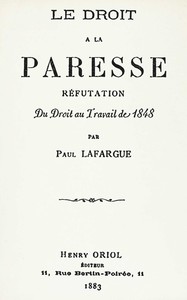
Le droit à la paresse : réfutation du droit au travail de 1848 by Paul Lafargue
So, what's this book actually about? There's no plot in the traditional sense—no characters or twists. Instead, think of it as a manifesto, a fiery argument against the idea that work is life's highest purpose. Lafargue published this in 1883, but he's responding to the 1848 French Revolution's promise of a 'right to work.' He says that promise is a cruel joke. It just means the right to be exploited. He paints a picture of workers destroying their own health and happiness in factories for meager pay, all while being told this grind is noble.
The Story
The 'story' is the argument itself. Lafargue walks us through history and economics to make his case. He points out how ancient societies often valued leisure and art, seeing constant labor as a curse. He then shows how the Industrial Revolution created a new religion of work, where machines that should make life easier instead demand more human toil. His villains are the factory owners and the moralists who preach that hard work is a virtue for the poor. His heroes are the lazy—the people who, by refusing to overwork, might just save civilization from collapsing under its own pointless productivity.
Why You Should Read It
You should read this because it's shockingly relevant. Reading it in 2024, during debates about burnout, the 4-day week, and 'quiet quitting,' feels like uncovering a prophecy. Lafargue's core idea—that our culture uses overwork to control and pacify people—hits hard. It's not a dry economic text; it's full of sarcasm, wit, and righteous anger. He calls out the hypocrisy of a system that preaches thrift to workers while encouraging wild consumption in the rich. It's a short, punchy read that will either infuriate you or feel like a massive relief. For me, it was the latter. It gave historical weight to my own vague feelings of modern exhaustion.
Final Verdict
This book is perfect for anyone feeling burned out by modern work culture, fans of radical political thought, or people who just enjoy a brilliantly argued, contrarian idea. It's a must-read for history buffs who want to see where critiques of capitalism began. It's also great for book clubs—it's short enough that everyone can finish it, and its ideas are guaranteed to start a fiery debate. Don't go in expecting practical solutions or a balanced view; go in for the intellectual spark, the historical curiosity, and the powerful, unsettling question: What if we've been getting work all wrong for centuries?
There are no legal restrictions on this material. You can copy, modify, and distribute it freely.
Linda Davis
1 year agoAmazing book.
Noah Lopez
11 months agoVery helpful, thanks.
Linda Wilson
1 year agoSimply put, it creates a vivid world that you simply do not want to leave. I will read more from this author.
Mark Ramirez
2 years agoPerfect.






Michelle Wright
6 months agoHelped me clear up some confusion on the topic.