About 78 minutes
Kinston, Whitehall and Goldsboro (North Carolina) expedition, December, 1862 — Edition Insights
Modern Nations
17,765 recorded words. 11 minutes difference from this book's estimate.
View Gutenberg source #24539
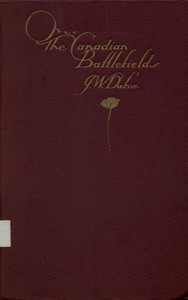
Over the Canadian Battlefields Notes of a Little Journey in France, in March, 1919 — Inside the Classic can be approached with a clearer sense of reading commitment from its source measurements: 15,293 words, 1 hr 7 min estimated reading time, and 3 detected text sections.
The text analysis averages about 31.9 words per sentence, while the detected sections provide another way to judge how the source is divided.
Project Gutenberg metadata also associates the work with “World War, 1914-1918 -- Personal narratives, Canadian,” connecting these edition facts with the source record’s subject description.
Explore this collection
These alternatives are selected using recorded categories and estimated reading time.
About 78 minutes
Modern Nations
17,765 recorded words. 11 minutes difference from this book's estimate.
View Gutenberg source #24539About 92 minutes
Modern Nations
21,000 recorded words. 25 minutes difference from this book's estimate.
View Gutenberg source #48714About 93 minutes
Modern Nations
21,363 recorded words. 26 minutes difference from this book's estimate.
View Gutenberg source #48808Search stored excerpts and compare books → Choose by your preferences →
Choices use stored catalog measurements. Estimates vary with reading speed. A shared category is a catalog label, not a claim that two books have the same argument or literary quality.
Search reads excerpt text stored with this catalog and links to its associated Gutenberg record. The connection is stored in the site database; this tool does not recheck that every excerpt is word-for-word identical to that external record. Excerpt search does not cover every chapter and does not verify historical publication dates.
Catalog snapshot checked: 2026-09-25. Coverage: 91 public books, 91 available source excerpts.
Read the complete public-domain text at its original source.
Read on Project GutenbergJohn W. Dafoe’s account of a quick tour through French battlefields in March 1919 is explicitly a journalist’s record, not a polished history. Written for the Manitoba Free Press and collected by request, the text retains its “journalistic origin” and “evanescent timeliness,” as the author notes in his foreword. The opening chapter frames the journey as a “pilgrimage” that future Canadians will make “with reverent hearts and shining eyes,” yet Dafoe’s own haste is palpable: he skips Flanders entirely, focusing instead on the Amiens sector and the Canadian Corps’ hammer blows in 1918.
Dafoe makes no secret of his constraints. He traveled in March 1919, “hurriedly and under weather conditions which were far” from ideal—the sentence breaks off in the excerpt, but the implication is clear. The book’s structure mirrors a reporter’s notebook: chapters with direct titles like “The Abomination of Desolation” and “The Marks of War.” Dafoe’s voice is brisk and factual, yet he occasionally slips into the rhetorical cadences of newspaper prose, as when he describes the Canadian advance at Amiens as “a daring and successful stroke well worth the telling.” The reader should expect a text that moves quickly, prioritizes specific actions over atmosphere, and never pretends to be a definitive military study.
The longest continuous excerpt in the provided material details the Canadian attack at Amiens on August 8, 1918. Dafoe emphasizes the secrecy of the troop movement: the Canadians were hidden in a “large semi-open wood” and moved forward at night with guides over unfamiliar ground. He notes the initial front of 7,000 yards between the Amiens-Roye road and the Amiens-Ham railway, with Australians on the left and French on the right. The 9th Brigade’s capture of Rifle Wood from the right of the road is singled out as a key maneuver. Dafoe also records that the terrain “shows the least signs of conflict” due to the rapid German retirement, a detail that contrasts with other battlefields he visited. This section reads like a dispatch, with precise geography and tactical notes, but Dafoe does not linger on personal emotion.
The book’s dedication to General Sir Arthur Currie, “the civilian commander of the conquering Canadian civilian army,” signals a recurring theme: the Canadian Corps as an extension of civilian society. Dafoe, himself a civilian journalist, was granted access by Currie, and the text often highlights the ordinary origins of the soldiers. In the Amiens account, he remarks that German commanders expected troops “experienced only in trench fighting” to falter in open warfare, a “catastrophic disappointment.” The phrase “civilian army” appears in the dedication and chapter titles, suggesting Dafoe saw the Canadians’ adaptability as a defining trait. The reader should watch for how Dafoe balances tactical reporting with this broader claim about national character.
Dafoe’s chapter “The Marks of War” is not excerpted, but its title hints at his method: he reads the landscape for evidence of conflict. In the Amiens section, he notes that the battlefield is visible from the highway and that a “competent guide” could easily tell the story. Yet the excerpts also reveal gaps. Dafoe mentions that he could not visit Flanders, and the text breaks off mid-sentence in the Amiens account. The book is a fragment of a larger tour, and Dafoe acknowledges its “evanescent timeliness.” Readers should treat the work as a primary source—a contemporary snapshot by a well-connected observer—rather than a comprehensive history. The author’s own admission that the articles were “not considered advisable… to re-cast” into permanent form underscores their provisional nature.
Dafoe’s little book is best approached as a period piece: a newspaperman’s quick sketch of battlefields still raw from war. Its value lies in its immediacy and its focus on the Canadian Corps’ 1918 offensives, particularly at Amiens. Readers interested in tactical detail or the perspective of a civilian observer will find it rewarding; those seeking a full narrative of the war should look elsewhere. The text invites us to see the ground through Dafoe’s eyes, even as he hurries past.
Reading Dafoe’s hurried notes from that grey March, I kept thinking how strange it is to walk a landscape where every hollow once held thunder. His quiet, factual jottings left me with a similar ache I once found in the Memoirs of Service Afloat, During the War Between the States — Inside the Classic, where even the calmest log entries carry the weight of what was lost. Some memories are simply carved into the soil, or the water.
Answer a few questions and save a private reflection on this device.









