
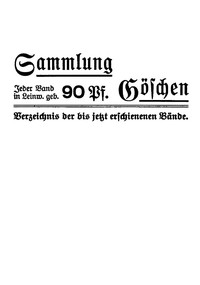
Sammlung Göschen: Verzeichnis der bis jetzt erschienen Bände
Let's clear this up right away: this is not a novel. 'Sammlung Göschen: Verzeichnis der bis jetzt erschienenen Bände' translates to 'Göschen Collection: Directory of Volumes Published to Date.' It's exactly what it says on the tin—a catalog. Published by the Göschen publishing house around the turn of the 20th century, this book simply lists all the titles available in their hugely popular 'Sammlung Göschen' series. Each entry typically includes the volume number, the author, and the title.
The Story
There's no plot, no characters. The 'narrative' is the list itself. Flipping through it, you journey through an entire miniature library. One page might list a volume on Kant's philosophy, the next a guide to differential calculus, followed by a handbook on Germanic antiquities and a text on plant physiology. The Göschen series was designed to be affordable and portable, putting specialized knowledge into the hands of students and the curious public. This book is the master key to that entire project.
Why You Should Read It
You read this for the vibe and the historical insight. It's a direct line to the intellectual landscape of its time. Holding this list, you're asking: What did people feel they needed to know? The range is stunning—hard sciences, soft humanities, technical skills—all presented as equally important. It speaks to a beautiful, almost quaint, faith in self-education and the democratization of learning. For me, it sparked imagination. I pictured a young apprentice buying the volume on physics, or a teacher saving up for the set on world history. It turns a dry catalog into a mirror of societal ambitions.
Final Verdict
This is a niche pick, but a rewarding one. It's perfect for history buffs, publishing nerds, or anyone fascinated by the social history of knowledge. If you love old bookstores and the smell of aged paper, you'll appreciate the context this provides. It's not a book you read cover-to-cover, but one you explore. Think of it as a primary source document, a puzzle piece for understanding how information circulated before our digital age. Don't expect a thrilling yarn; expect a quiet, thought-provoking artifact that tells a bigger story about what we value and how we share it.
No rights are reserved for this publication. Distribute this work to help spread literacy.
Joseph Harris
1 year agoI was skeptical about the depth of this book at first, but the logic behind each conclusion is easy to follow and verify. A trustworthy resource that I'll keep in my digital library.
Joshua Hernandez
7 months agoVery interesting perspective.
Emily Robinson
7 months agoFinally a version with clear text and no errors.
Mason Hill
1 year agoFast paced, good book.


Jessica Lee
7 months agoThis is an essential addition to any academic digital library.