
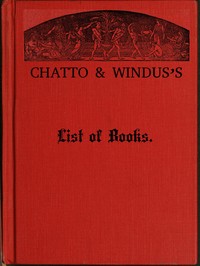
Chatto & Windus's List of Books, July 1878 by Chatto & Windus
Let's be clear from the start: this is not a novel. There's no plot in the traditional sense, no characters to follow. Chatto & Windus's List of Books, July 1878 is a historical artifact—a sales catalog published by a major London firm to advertise their wares to booksellers and the reading public.
The Story
The 'story' is the snapshot it provides. Page by page, it lays out what one publisher had available in the summer of 1878. You'll find everything from expensive multi-volume sets of fiction (the Victorian equivalent of a binge-worthy TV series) to single-volume poetry, history, biography, and practical manuals. The entries are brief, often just a title, author, price, and format (like 'crown 8vo, cloth'). The narrative is in the collection itself. Why is a book on French vineyards listed beside a collection of ghost stories? What does it say that travel narratives to America and Egypt were popular? The catalog doesn't explain; it just presents the evidence, leaving you to connect the dots.
Why You Should Read It
I loved this because it feels like detective work. You're not being told about Victorian culture; you're seeing its raw materials. It strips away a century of analysis and shows you what was literally on the market. You get a real sense of the breadth of interests—it wasn't all stern moral tales. There's humor, adventure, science, and scandal. The prices are also startling, reminding you how expensive books were and who could afford them. Flipping through it, I kept imagining who might have ordered each item: a gentleman for his library, a father buying a gift, a curious student. It makes history feel personal and tangible, not just a series of dates and events.
Final Verdict
This is a niche pick, but a brilliant one for the right reader. It's perfect for history buffs, bibliophiles, and writers of historical fiction who crave authentic detail. If you enjoy getting lost in archives or love the physicality of old books, you'll find this catalog utterly absorbing. It's not a page-turner in the usual way, but it is a compelling portal to another time. Think of it as the most detailed, primary-source 'recommendation list' you'll ever find from the 19th century. Just be warned: you'll probably end up with a whole new list of obscure old books you now want to read.
This work has been identified as being free of known copyright restrictions. Feel free to use it for personal or commercial purposes.
Susan Miller
4 months agoThis digital copy caught my eye due to its reputation, the author clearly has a deep mastery of the subject matter. I appreciate the effort that went into this curation.
Joshua Smith
6 months agoPerfect.
Matthew Martinez
11 months agoSurprisingly enough, the depth of research presented here is truly commendable. I will read more from this author.
Betty Flores
7 months agoI started reading out of curiosity and the clarity of the writing makes this accessible. Definitely a 5-star read.

Nancy Thompson
1 year agoIt took me a while to process the complex ideas here, but the bibliography and references suggest a high level of research and authority. If you want to master this topic, start right here.