
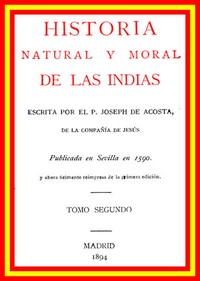
Historia natural y moral de las Indias (vol. 2 of 2) by José de Acosta
This isn't a novel with a plot, but the story it tells is incredible. Think of it as a 16th-century field report. José de Acosta was a Jesuit missionary who spent years in the Spanish territories of the Americas. In this second volume, he moves from describing the physical land (which he did in Volume 1) to examining its people and their societies.
The Story
Acosta organizes his observations like a curious scientist. He writes about the natural phenomena that amazed Europeans: what causes the winds in the Andes, why the sky looks different in the Southern Hemisphere, and how earthquakes work. Then, he turns to human history. He records the customs, governments, and religions of the Aztec and Inca empires with a mix of scholarly interest and missionary disapproval. He tries to piece together how people might have first come to the Americas. The whole book is his attempt to create a unified 'natural and moral history'—to explain both the physical world and human civilization in the Americas within a Christian framework.
Why You Should Read It
This book is a time machine. You're not getting a modern, polished history lesson. You're getting the raw, first-draft thoughts of a smart, observant man who was there. His confusion about llamas and potatoes is funny. His detailed notes on Inca engineering are respectful and impressive. But you also can't ignore his firm belief in Spanish and Christian superiority, which colors everything. Reading it requires holding two ideas at once: appreciating his genuine curiosity and wrestling with the colonial mindset he represents. That tension is what makes it so powerful and important. It shows the very moment of encounter, before the stories were simplified by time.
Final Verdict
Perfect for history buffs who want to go beyond textbooks and hear a direct voice from the past. It's also great for anyone interested in the history of science, exploration, or cultural contact. If you enjoyed books like Guns, Germs, and Steel but want to see the primary source material from the ground level, this is your book. Just be ready to read critically and contextually. It’s not an easy beach read, but for the right reader, it’s absolutely fascinating.
The copyright for this book has expired, making it public property. Use this text in your own projects freely.
Oliver Lewis
1 year agoTo be perfectly clear, the storytelling feels authentic and emotionally grounded. Don't hesitate to start reading.
Kimberly Gonzalez
1 year agoGreat digital experience compared to other versions.
Susan Scott
1 year agoAfter hearing about this author multiple times, it creates a vivid world that you simply do not want to leave. Thanks for sharing this review.
Kevin Lewis
1 year agoI started reading out of curiosity and the storytelling feels authentic and emotionally grounded. A valuable addition to my collection.

Aiden Harris
1 year agoEssential reading for students of this field.